
Two questions come up more than any others: does cocoa cause breakouts, and is it actually good for you. The honest answers are more interesting than either the folk wisdom or the marketing. Here is what the trials and the regulators actually say.
Does cocoa cause acne?
“Chocolate causes spots” is usually dismissed as an old wives’ tale. That dismissal is too quick. The question has been put to controlled trials, and the results are more mixed than either camp likes.
DOUBLE-BLIND, PLACEBO-CONTROLLED
Caperton and colleagues (Journal of Clinical and Aesthetic Dermatology, 7(5), 2014) gave 14 men aged 18–35 with a history of acne up to six ounces of 100% unsweetened cocoa in capsule form, as a single consumption event. Total acneiform lesions rose with statistical significance at day 4 (p = 0.006) and day 7 (p = 0.043), with a dose-dependent correlation.
The authors list five limitations themselves: a very small sample (14), no female participants, a single brand, and — the important one — a one-time binge that does not reflect ordinary consumption.
That last point deserves emphasis. Six ounces of pure cocoa powder in one sitting is roughly 17 to 34 times the amount in a normal cup of drinking chocolate. The trial says little about a daily cup.
Other trials disagree with each other. One crossover study comparing milk chocolate against jelly beans matched for sugar found lesions increased in the chocolate arm but not the jelly bean arm. Another, in 57 volunteers, compared white chocolate, 100% dark chocolate and no chocolate: the white chocolate group worsened; the dark chocolate and control groups did not. The overall picture is a signal, not a settled finding, and every sample is small.
The honest verdict
| Statement | Strength of evidence |
|---|---|
| In acne-prone people, very large amounts of cocoa over a short period can worsen lesions | Supported by trial data, but small samples and unrealistic doses |
| Sugar and milk in the product are part of the picture | The white chocolate trial worsened where the dark chocolate arm did not |
| A daily cup of pure cocoa causes breakouts in the general population | No evidence at that dose |
| Cocoa raises body temperature | No documented physiological basis |
Put plainly: if you are acne-prone and you have just eaten half a box of chocolates, your skin’s response is not imaginary. Attributing it to one morning cup is another matter entirely.
What regulators have actually approved
This is where it pays to separate marketing from assessment.
EUROPE — EFSA
The European Food Safety Authority approved the claim: “Cocoa flavanols help maintain the elasticity of blood vessels, which contributes to normal blood flow.”
Conditions of use: 200 mg of cocoa flavanols daily, with a degree of polymerisation of 1–10. The claim was subsequently written into EU regulation.
UNITED STATES — FDA
On 3 February 2023 the FDA announced a qualified health claim for high flavanol cocoa powder containing at least 4% naturally conserved cocoa flavanols.
Notably, the FDA requires the qualifier to travel with the claim: “the FDA has concluded that there is very limited scientific evidence for this claim.” That is the weakest rung on the ladder, and it should be reported as such.
Why alkalization is directly relevant
If flavanols are the reason you drink cocoa, the processing decides almost everything.
Miller and colleagues (Journal of Agricultural and Food Chemistry, 56(18), 2008) measured flavanol content by alkalization level:
| Treatment | pH | Total flavanols (mg/g) | Retained |
|---|---|---|---|
| Natural (non-alkalized) | 5.39–5.76 | 34.6 ± 6.8 | 100% |
| Lightly alkalized | 6.50–7.20 | 13.8 ± 7.3 | ~40% |
| Medium | 7.21–7.60 | 7.8 ± 4.0 | ~22% |
| Heavy | 7.61 and above | 3.9 ± 1.8 | ~11% |
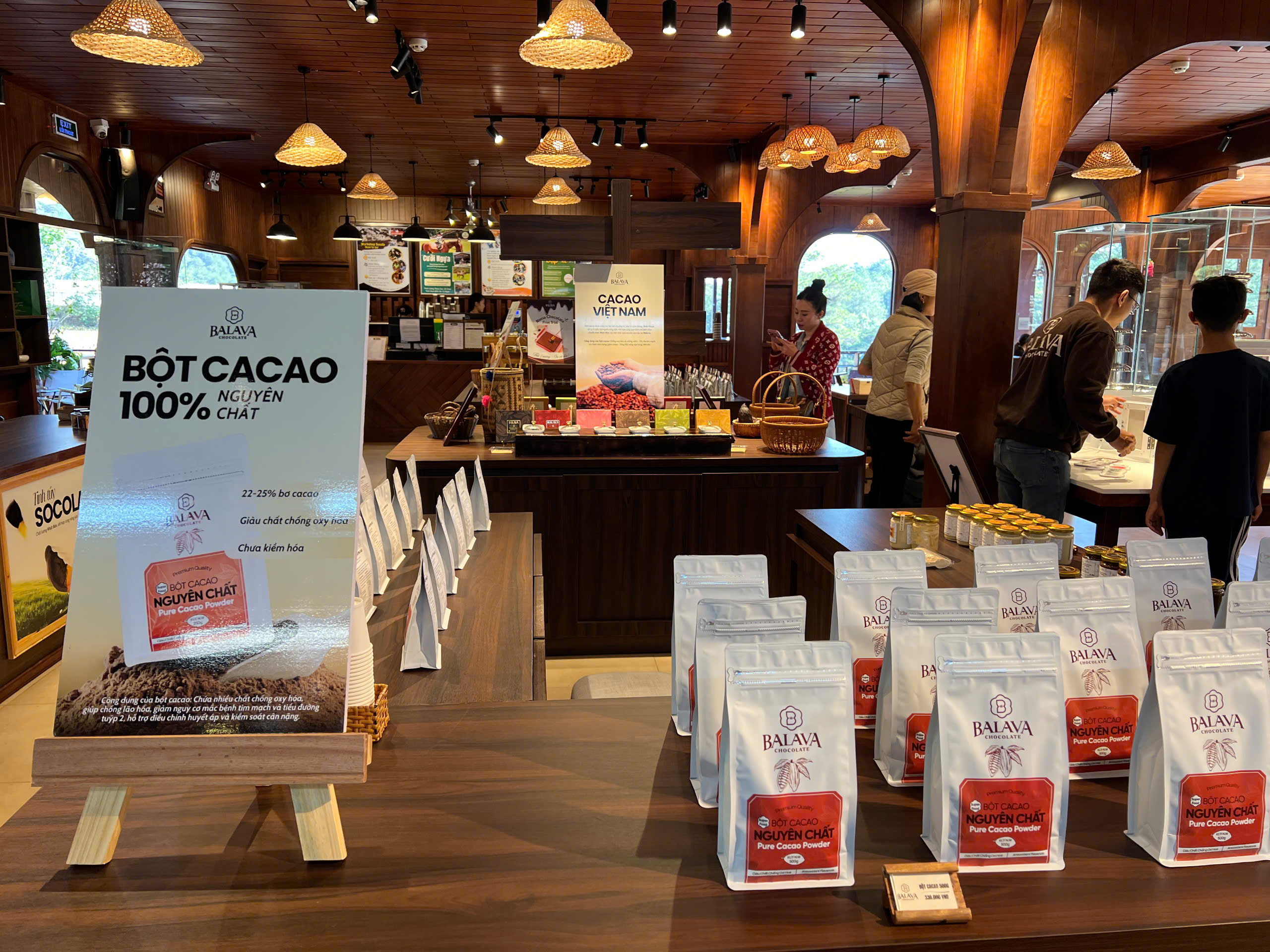
Heavily Dutched cocoa retains roughly a tenth of the original flavanols. BALAVA cocoa powder is non-alkalized and retains 22–25% cocoa butter.
Nutritional composition, per USDA
| Component | Per 100 g | Per 10 g (a heaped tablespoon) |
|---|---|---|
| Energy | 228 kcal | ~23 kcal |
| Dietary fibre | 37.0 g | ~3.7 g |
| Magnesium | 499 mg | ~50 mg |
| Iron | 13.9 mg | ~1.4 mg |
| Potassium | 1,524 mg | ~152 mg |
| Zinc | 6.8 mg | ~0.7 mg |
| Theobromine | 2,057 mg | ~206 mg |
| Caffeine | 230 mg | ~23 mg |
The two figures that stand out are magnesium and fibre. By weight, unsweetened cocoa powder is among the richest common sources of magnesium. Note that these values are for unsweetened powder; a sweetened drinking mix is a different nutritional object entirely.
Things worth knowing
| Issue | Detail |
|---|---|
| Sugar | Most of the harm attributed to cocoa comes from the sugar and milk in prepared products. Pure cocoa powder and instant drinking chocolate are not the same category. |
| Theobromine and sleep | Theobromine has a serum half-life of roughly 6 to 10 hours. Sensitive individuals should avoid it late in the day. |
| Cadmium | Cacao takes up cadmium from soil. The EU sets a maximum of 0.60 mg/kg for cocoa powder and 0.10 to 0.80 mg/kg for chocolate depending on cocoa content. It is a reasonable question to put to any supplier. |
| Dogs | Theobromine is toxic to dogs. Do not give chocolate or cocoa powder to pets. |
Disclaimer. This article is informational and compiled from the cited studies and regulatory documents. It is not medical advice and does not replace a doctor’s opinion. Anyone with an underlying condition, who is pregnant, taking medication or prone to allergy should seek professional advice before changing their diet.
Talk to BALAVA
Wholesale pricing, private label, samples and export documentation — we answer in English.
Sources. Cocoa and acne trial: Caperton C., Block S., Viera M., Keri J., Berman B., “Double-blind, Placebo-controlled Study Assessing the Effect of Chocolate Consumption in Subjects with a History of Acne Vulgaris”, Journal of Clinical and Aesthetic Dermatology 7(5), 2014. European health claim: European Food Safety Authority, scientific opinion on cocoa flavanols and maintenance of normal endothelium-dependent vasodilation, pursuant to Article 13(5) of Regulation (EC) No 1924/2006. US qualified health claim: FDA constituent update, 3 February 2023. Alkalization and flavanol retention: Miller K.B. et al., Journal of Agricultural and Food Chemistry 56(18), 2008. Nutritional composition: USDA FoodData Central, cocoa, dry powder, unsweetened. Cadmium limits: Regulation (EU) 2023/915. BALAVA product specifications are supplied by BALAVA.
Other review products