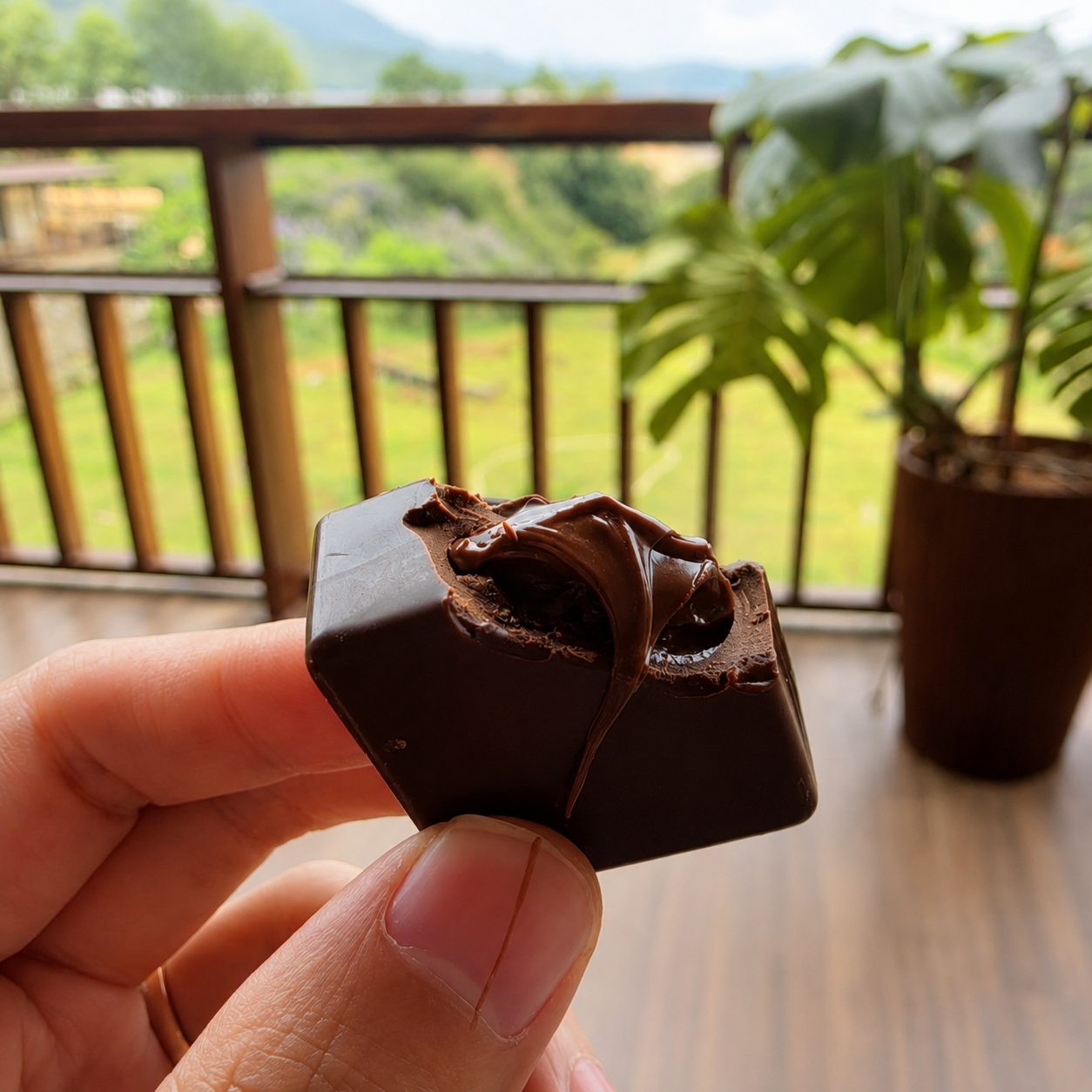
Some chocolate collapses on the tongue within seconds, smooth and completely gone. Some has to be chewed, melts slowly and leaves a waxy film on the palate. The difference is real and measurable. But the conclusion “fast melting means good, slow melting means bad” is only half right.

Why chocolate melts in the mouth but not in the hand
The answer is cocoa butter. It is one of very few natural fats with a narrow melting range sitting just below body temperature. Most fats soften gradually across a wide band, which is what produces a lingering greasy sensation. Cocoa butter changes phase almost at once: solid, then liquid.
But cocoa butter does not crystallise in only one way. It has six crystal forms, numbered I to VI, each with its own melting point. The entire craft of tempering exists to force cocoa butter to crystallise specifically into Form V.
| Crystal form | Behaviour |
|---|---|
| Form V — melts at about 33.8°C | The target of tempering. Glossy surface, a clean audible snap, and a decisive melt in the mouth because body temperature sits above its melting point. |
| Form VI — melts at about 36.2°C | The more stable form, developing gradually over time or under poor storage. Dull surface, softer texture, and a slow melt because its melting point has risen past body temperature. |
| Forms I–IV | Less stable, melting lower. Untempered or badly tempered chocolate lands here — soft, without gloss, quick to bloom. |
Here is the crux: body temperature is around 37°C. Form V sits below that line, so it melts. Form VI sits at or above it, so it does not melt completely. The same recipe from the same batch, differing only in crystal form, produces two entirely different experiences.

Four reasons chocolate melts slowly
One: conversion to Form VI. An older bar, or one that has warmed and cooled repeatedly, gradually converts to the more stable form. This usually comes with a dulled surface or visible bloom.
Two: poor tempering. The product left the workshop wrong. You can see it in the absence of gloss and in a crumbly rather than clean break.
Three: fats other than cocoa butter. This is the most common cause in low-price products. Cocoa butter substitutes and replacers — typically based on palm kernel or coconut oil — are considerably cheaper and need no tempering, but they melt higher and across a wider range. The result is exactly as described: slow melt, waxy finish.
Four: low total fat. Less fat means less to melt. The sensation is drier and more powdery, even when the fat present is genuine cocoa butter.
What the regulation says. EU Directive 2000/36/EC requires dark chocolate to contain at least 35% total dry cocoa solids, of which at least 18% cocoa butter and 14% fat-free cocoa solids, and permits a maximum of 5% of six specified vegetable fats. Above that threshold a product may not be sold as chocolate in the EU. Reading the ingredient list is the reliable check — if “vegetable fat” appears high in the list, or the product is described as a chocolate-flavoured confection rather than chocolate, that is your answer.
But slow melting is not always a fault
One case breaks the simple conclusion: heat-resistant chocolate. For hot-climate markets, producers deliberately raise the melting point so the product survives a distribution chain without refrigeration. That is a considered engineering decision, not carelessness — it simply trades mouth-melt for heat tolerance.
Put differently, melting behaviour is a good indicator of which fat is present and what crystal state it is in, not a direct measure of the quality of the cacao. A bar made from outstanding beans but tempered badly will melt worse than a bar of ordinary beans tempered correctly.

Three tests you can run at home
The snap test. Break a piece at room temperature. Correct temper gives a clean audible snap and a sharp fracture face. A crumbly, soft, silent break suggests poor temper or substitute fat.
The tongue test. Place a piece on the tongue and do not chew. Cocoa butter in Form V collapses smoothly in roughly ten to twenty seconds. If after half a minute it is still intact and feels waxy, the fat in it is not only cocoa butter, or the crystal form has shifted.
The fingertip test. Hold a small piece between two fingers. Form V cocoa butter begins to soften fairly quickly because skin temperature is above its melting point. A piece that stays rigid indefinitely has a melting point above body temperature.

Talk to BALAVA
Wholesale pricing, private label, samples and export documentation — we answer in English.
Sources. The six polymorphic forms of cocoa butter (I–VI) are the classical classification in fat science; Form V melts at approximately 33.8°C and Form VI at approximately 36.2°C. Composition thresholds for dark chocolate (minimum 35% dry cocoa solids, of which 18% cocoa butter and 14% fat-free cocoa solids) and the 5% limit on other vegetable fats: EU Directive 2000/36/EC. Body temperature is taken as approximately 37°C. The sensory tests described are common industry practice and are qualitative rather than measurements. BALAVA uses pure cocoa butter and no substitute fats.
Other review products